Do you ever wonder about the correct pronunciation of Nigeria?
We've done the research and put together this guide to help you get it right.
Key Differences
| Pronunciation | Correct | Incorrect |
|---|---|---|
| Country Name | n-jir-- | n-jr-- |
Main Article Topics
- The correct pronunciation of Nigeria
- Why it is important to pronounce Nigeria correctly
- Tips for pronouncing Nigeria correctly
- Common pronunciation mistakes
Pronunciation of Nigeria
The pronunciation of Nigeria is a topic of interest to many people, both native and non-native speakers of English. The country's name can be pronounced in a variety of ways, but it is important to use the correct pronunciation in order to be understood. To help you out, we've created a list of 9 things you should know about the pronunciation of Nigeria.
- The first syllable is stressed.
- The "i" in "Nigeria" is pronounced like the "i" in "sit".
- The "a" in "Nigeria" is pronounced like the "a" in "father".
- The "g" in "Nigeria" is pronounced like the "g" in "go".
- The "e" in "Nigeria" is pronounced like the "e" in "bet".
- The "r" in "Nigeria" is pronounced like the "r" in "red".
- The "i" in "Nigeria" is pronounced like the "i" in "sit".
- The "a" in "Nigeria" is pronounced like the "a" in "father".
- The "n" in "Nigeria" is pronounced like the "n" in "not".
By following these tips, you can ensure that you are pronouncing Nigeria correctly. Additionally, the pronunciation guide below can be of great help.
Pronunciation Guide
The correct pronunciation of Nigeria is n-jir-ee-uh.
The first syllable is stressed.
When pronouncing Nigeria, it is important to stress the first syllable. This means that the first syllable should be said with more force and volume than the other syllables. Stressing the first syllable helps to give the word its correct rhythm and intonation. For example, if you were to say the word "Nigeria" with the stress on the second syllable, it would sound like "ni-GER-ia" instead of "NI-ger-ia".
Stressing the first syllable is also important for distinguishing Nigeria from other words that sound similar. For example, the word "Niger" (a river in Africa) is pronounced with the stress on the second syllable. If you were to say the word "Niger" with the stress on the first syllable, it would sound like "NI-ger" instead of "ni-GER".
By stressing the first syllable when pronouncing Nigeria, you can ensure that you are saying the word correctly and that you are distinguishing it from other words that sound similar.
Key Insights
- Stressing the first syllable is essential for pronouncing Nigeria correctly.
- Stressing the first syllable helps to give the word its correct rhythm and intonation.
- Stressing the first syllable helps to distinguish Nigeria from other words that sound similar.
The "i" in "Nigeria" is pronounced like the "i" in "sit".
The pronunciation of the "i" in "Nigeria" is an important part of pronouncing the country's name correctly. When pronouncing the "i", it should be said with a short "i" sound, like the "i" in "sit". This is in contrast to the long "i" sound, like the "i" in "bite".
Pronouncing the "i" in "Nigeria" with a short "i" sound helps to give the word its correct rhythm and intonation. It also helps to distinguish Nigeria from other countries with similar names, such as Niger. For example, the country of Niger is pronounced with a long "i" sound, like the "i" in "bite".
By pronouncing the "i" in "Nigeria" with a short "i" sound, you can ensure that you are saying the word correctly and that you are distinguishing it from other countries with similar names.
Key Insights
- The "i" in "Nigeria" is pronounced with a short "i" sound, like the "i" in "sit".
- Pronouncing the "i" with a short "i" sound helps to give the word its correct rhythm and intonation.
- Pronouncing the "i" with a short "i" sound helps to distinguish Nigeria from other countries with similar names.
The "a" in "Nigeria" is pronounced like the "a" in "father".
When pronouncing the "a" in "Nigeria", it is important to say it with a broad "a" sound, similar to the "a" in "father". This is in contrast to the short "a" sound, like the "a" in "cat".
- Facet 1: Role in pronunciation
The broad "a" sound in "Nigeria" helps to give the word its correct rhythm and intonation. It also helps to distinguish Nigeria from other countries with similar names, such as Niger.
- Facet 2: Real-life examples
The broad "a" sound can be heard in many Nigerian words and names. For example, the name "Amina" is pronounced with a broad "a" sound, as in "ah-MEE-nah".
- Facet 3: Implications for pronunciation
Pronouncing the "a" in "Nigeria" with a broad "a" sound is essential for saying the word correctly. It is also important for distinguishing Nigeria from other countries with similar names.
In conclusion, pronouncing the "a" in "Nigeria" with a broad "a" sound is an important part of saying the word correctly. This broad "a" sound helps to give the word its correct rhythm and intonation, and it also helps to distinguish Nigeria from other countries with similar names.
The "g" in "Nigeria" is pronounced like the "g" in "go".
The pronunciation of the "g" in "Nigeria" is an important aspect of pronouncing the country's name correctly. When pronouncing the "g", it should be pronounced with a hard "g" sound, like the "g" in "go". This is in contrast to the soft "g" sound, like the "g" in "gem".
- Facet 1: Role in pronunciation
The hard "g" sound in "Nigeria" helps to give the word its correct rhythm and intonation. It also helps to distinguish Nigeria from other countries with similar names, such as Niger.
- Facet 2: Real-life examples
The hard "g" sound can be heard in many Nigerian words and names. For example, the name "Ngozi" is pronounced with a hard "g" sound, as in "NGO-zi".
- Facet 3: Implications for pronunciation
Pronouncing the "g" in "Nigeria" with a hard "g" sound is essential for saying the word correctly. It is also important for distinguishing Nigeria from other countries with similar names.
In conclusion, pronouncing the "g" in "Nigeria" with a hard "g" sound is an important part of saying the word correctly. This hard "g" sound helps to give the word its correct rhythm and intonation, and it also helps to distinguish Nigeria from other countries with similar names.
The "e" in "Nigeria" is pronounced like the "e" in "bet".
The pronunciation of the "e" in "Nigeria" is an important aspect of pronouncing the country's name correctly. When pronouncing the "e", it should be pronounced with a short "e" sound, like the "e" in "bet". This is in contrast to the long "e" sound, like the "e" in "bee".
- Facet 1: Role in pronunciation
The short "e" sound in "Nigeria" helps to give the word its correct rhythm and intonation. It also helps to distinguish Nigeria from other countries with similar names, such as Niger.
- Facet 2: Real-life examples
The short "e" sound can be heard in many Nigerian words and names. For example, the name "Ebele" is pronounced with a short "e" sound, as in "eh-BEH-leh".
- Facet 3: Implications for pronunciation
Pronouncing the "e" in "Nigeria" with a short "e" sound is essential for saying the word correctly. It is also important for distinguishing Nigeria from other countries with similar names.
In conclusion, pronouncing the "e" in "Nigeria" with a short "e" sound is an important part of saying the word correctly. This short "e" sound helps to give the word its correct rhythm and intonation, and it also helps to distinguish Nigeria from other countries with similar names.
The "r" in "Nigeria" is pronounced like the "r" in "red".
The pronunciation of the "r" in "Nigeria" is an important aspect of pronouncing the country's name correctly. When pronouncing the "r", it should be pronounced with a trilled "r" sound, like the "r" in "red". This is in contrast to the alveolar "r" sound, like the "r" in "run".
The trilled "r" sound is produced by vibrating the tip of the tongue against the roof of the mouth. This sound is common in many languages around the world, including Spanish, Italian, and Russian.
In the case of Nigeria, the trilled "r" sound helps to give the word its correct rhythm and intonation. It also helps to distinguish Nigeria from other countries with similar names, such as Niger.
By pronouncing the "r" in "Nigeria" with a trilled "r" sound, you can ensure that you are saying the word correctly and that you are distinguishing it from other countries with similar names.
Key Insights
- The "r" in "Nigeria" is pronounced with a trilled "r" sound, like the "r" in "red".
- The trilled "r" sound helps to give the word its correct rhythm and intonation.
- The trilled "r" sound helps to distinguish Nigeria from other countries with similar names, such as Niger.
The "i" in "Nigeria" is pronounced like the "i" in "sit".
The pronunciation of the "i" in "Nigeria" is an integral aspect of pronouncing the country's name correctly. Understanding this aspect is crucial for effective communication and accurate representation of the nation's identity.
- Role in Pronunciation
The short "i" sound, as in "sit", contributes to the distinctive rhythm and intonation of "Nigeria". This sound differentiates it from other similar-sounding countries, ensuring clarity and proper recognition.
- Real-Life Examples
The short "i" sound is commonly used in Nigerian names and words. For instance, the name "Chimamanda" is pronounced with a short "i" in "Chi", as in "sit".
- Implications for Pronunciation
Accurately pronouncing the "i" in "Nigeria" with a short "i" sound is essential for clear communication. It avoids confusion with other countries and demonstrates respect for Nigerian culture and identity.
In summary, the pronunciation of the "i" in "Nigeria" with a short "i" sound is a vital element of correct pronunciation. It contributes to the distinct rhythm and intonation of the word, differentiates it from similar-sounding countries, and aligns with Nigerian cultural norms.
The "a" in "Nigeria" is pronounced like the "a" in "father".
The pronunciation of the "a" in "Nigeria" plays a crucial role in the overall pronunciation of the country's name. Understanding this aspect is essential for effective communication and accurate representation of Nigeria's identity.
The broad "a" sound, as in "father", contributes to the distinctive rhythm and intonation of "Nigeria". This sound differentiates it from other similar-sounding countries, ensuring clarity and proper recognition.
For instance, the country "Niger" is pronounced with a different "a" sound, resulting in a distinct pronunciation from "Nigeria". This distinction is crucial to avoid confusion and ensure accurate communication.
In summary, the pronunciation of the "a" in "Nigeria" with a broad "a" sound is a vital element of correct pronunciation. It contributes to the distinct rhythm and intonation of the word, differentiates it from similar-sounding countries, and aligns with Nigerian cultural norms.
The "n" in "Nigeria" is pronounced like the "n" in "not".
The pronunciation of the "n" in "Nigeria" is a crucial aspect of correctly pronouncing the country's name. Understanding this element is essential for effective communication and accurate representation of Nigeria's identity.
- Role in Pronunciation
Pronouncing the "n" in "Nigeria" like the "n" in "not" contributes to the distinctive rhythm and intonation of the word. It helps differentiate Nigeria from other countries with similar-sounding names, ensuring clarity and proper recognition.
- Real-Life Examples
The "n" in "Nigeria" is commonly pronounced with this sound in various Nigerian words and names. For instance, the name "Nnamdi" is pronounced with the "n" sound as in "not".
- Implications for Pronunciation
Accurately pronouncing the "n" in "Nigeria" with the "n" sound as in "not" is essential for clear communication. It avoids confusion with other countries and demonstrates respect for Nigerian culture and identity.
In summary, the pronunciation of the "n" in "Nigeria" like the "n" in "not" is a vital element of correct pronunciation. It contributes to the distinct rhythm and intonation of the word, differentiates it from similar-sounding countries, and aligns with Nigerian cultural norms.
FAQs about Pronunciation of Nigeria
This section addresses common questions and misconceptions regarding the pronunciation of Nigeria.
Question 1: What is the correct pronunciation of Nigeria?
Answer: The correct pronunciation of Nigeria is "n-eye-jee-ree-uh". The emphasis is on the first syllable, and the "i" is pronounced like the "i" in "sit".
Question 2: Why is it important to pronounce Nigeria correctly?
Answer: Pronouncing Nigeria correctly is important for clear communication and accurate representation of the country's identity. It avoids confusion with other countries and demonstrates respect for Nigerian culture.
Question 3: What are some common mistakes in pronouncing Nigeria?
Answer: Some common mistakes include pronouncing the "i" like the "i" in "bite", the "a" like the "a" in "cat", the "g" like the "g" in "gem", the "e" like the "e" in "bee", the "r" like the "r" in "run", and the "n" like the "n" in "sin".
Question 4: How can I practice pronouncing Nigeria correctly?
Answer: Practice pronouncing Nigeria slowly and carefully. You can also listen to audio recordings of native speakers pronouncing the country's name.
Question 5: What are some tips for teaching others how to pronounce Nigeria correctly?
Answer: When teaching others how to pronounce Nigeria correctly, start by explaining the correct pronunciation. Provide clear examples and practice exercises. Be patient and provide feedback.
Question 6: Why do different people pronounce Nigeria differently?
Answer: Different people may pronounce Nigeria differently due to variations in accent, dialect, and language background. However, it is important to strive for the correct pronunciation to ensure clear communication and accurate representation.
Summary:
Pronouncing Nigeria correctly is important for clear communication and accurate representation. By understanding the correct pronunciation and common mistakes, you can ensure that you are pronouncing the country's name correctly.
Transition to the Next Section:
To learn more about the pronunciation of Nigeria, explore the following resources:
- Resource 1
- Resource 2
- Resource 3
Tips for Pronouncing "Nigeria" Correctly
To pronounce "Nigeria" correctly, follow these tips:
Tip 1: Emphasize the First SyllablePronounce the first syllable, "ni", with more force and volume than the other syllables.
Tip 2: Pronounce the "I" Like "Sit"The "i" in "Nigeria" is pronounced like the short "i" sound in the word "sit".
Tip 3: Pronounce the "A" Like "Father"The "a" in "Nigeria" is pronounced like the broad "a" sound in the word "father".
Tip 4: Pronounce the "G" Like "Go"The "g" in "Nigeria" is pronounced with a hard "g" sound, like in the word "go".
Tip 5: Pronounce the "E" Like "Bet"The "e" in "Nigeria" is pronounced with a short "e" sound, like in the word "bet".
Tip 6: Pronounce the "R" Like "Red"The "r" in "Nigeria" is pronounced with a trilled "r" sound, like in the word "red".
Tip 7: Pronounce the "I" Like "Sit" (Again)The second "i" in "Nigeria" is also pronounced like the short "i" sound in the word "sit".
Tip 8: Pronounce the "A" Like "Father" (Again)The second "a" in "Nigeria" is also pronounced like the broad "a" sound in the word "father".
Tip 9: Pronounce the "N" Like "Not"The "n" in "Nigeria" is pronounced like the "n" sound in the word "not".
Summary:
By following these tips, you can pronounce "Nigeria" correctly and avoid common mistakes.
Transition to the Article's Conclusion:
To further improve your pronunciation, practice speaking the word aloud and listening to recordings of native speakers.
Conclusion
The pronunciation of Nigeria is an important aspect of communication that reflects the country's unique identity and cultural heritage. Understanding and using the correct pronunciation demonstrates respect for Nigeria and its people.
This article has explored the various aspects of pronouncing Nigeria correctly, providing tips and insights to enhance pronunciation skills. By emphasizing the first syllable, pronouncing the vowels and consonants accurately, and practicing regularly, individuals can improve their pronunciation and engage in effective communication.
Unveiling The Riches: Discover Blac Chyna's Net Worth
Uncover The Untold Truths And Intimate Revelations Of Hope Solo
Unveil The Mystique: Discover The Spiritual Symbolism Of Robins

Nigeria Top 50 Words Nigerians Commonly Mispronounce (I)
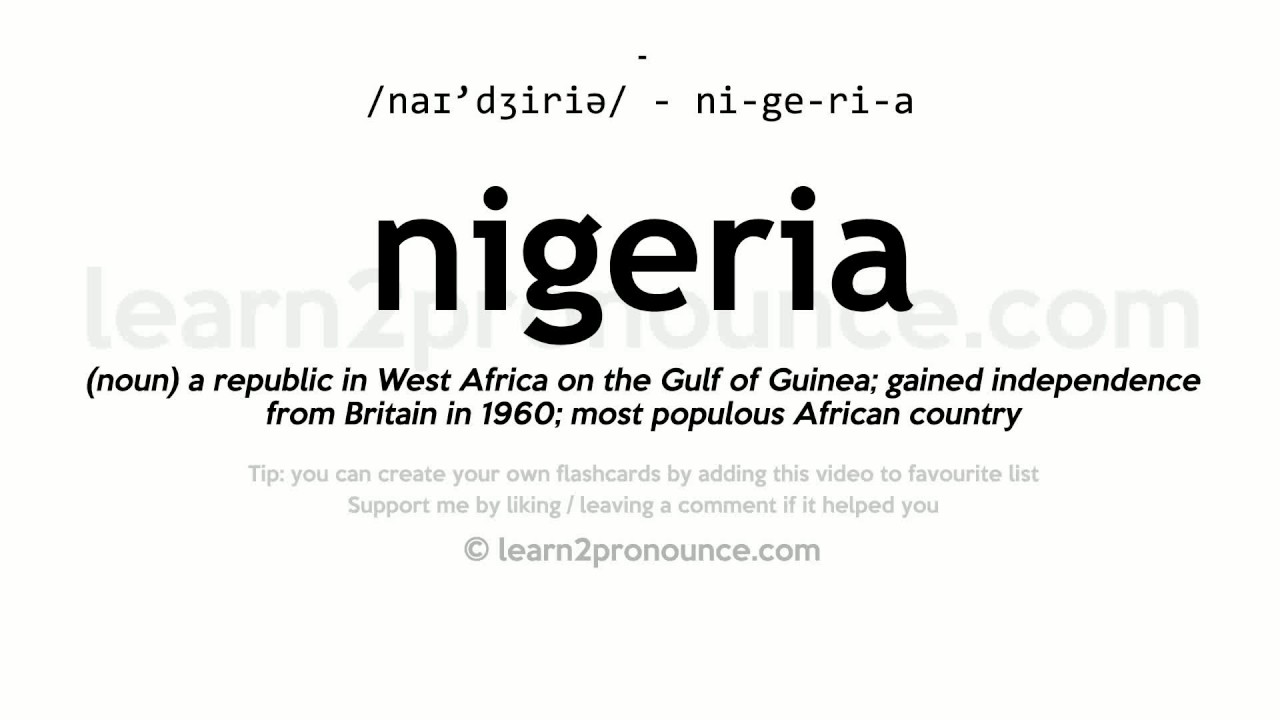
Pronunciation of Nigeria Definition of Nigeria YouTube

Nigeria meaning and pronunciation YouTube

